


The Ultimate Guide to AA Batteries: Types, Uses & More
Whether you're trying to save money, reduce your environmental footprint, or just get the most out of your tech devices, choosing the right type of AA battery matters.



The rechargeable battery market has changed more in the last few years than in the previous twenty. For decades, your only real option was nickel-metal hydride (NiMH): the Eneloops, the Energizers, the Amazons Basics of the world. They all worked roughly the same way: buy batteries, buy a separate charger, wait a few hours, and expect an experience noticeably worse than single-use.
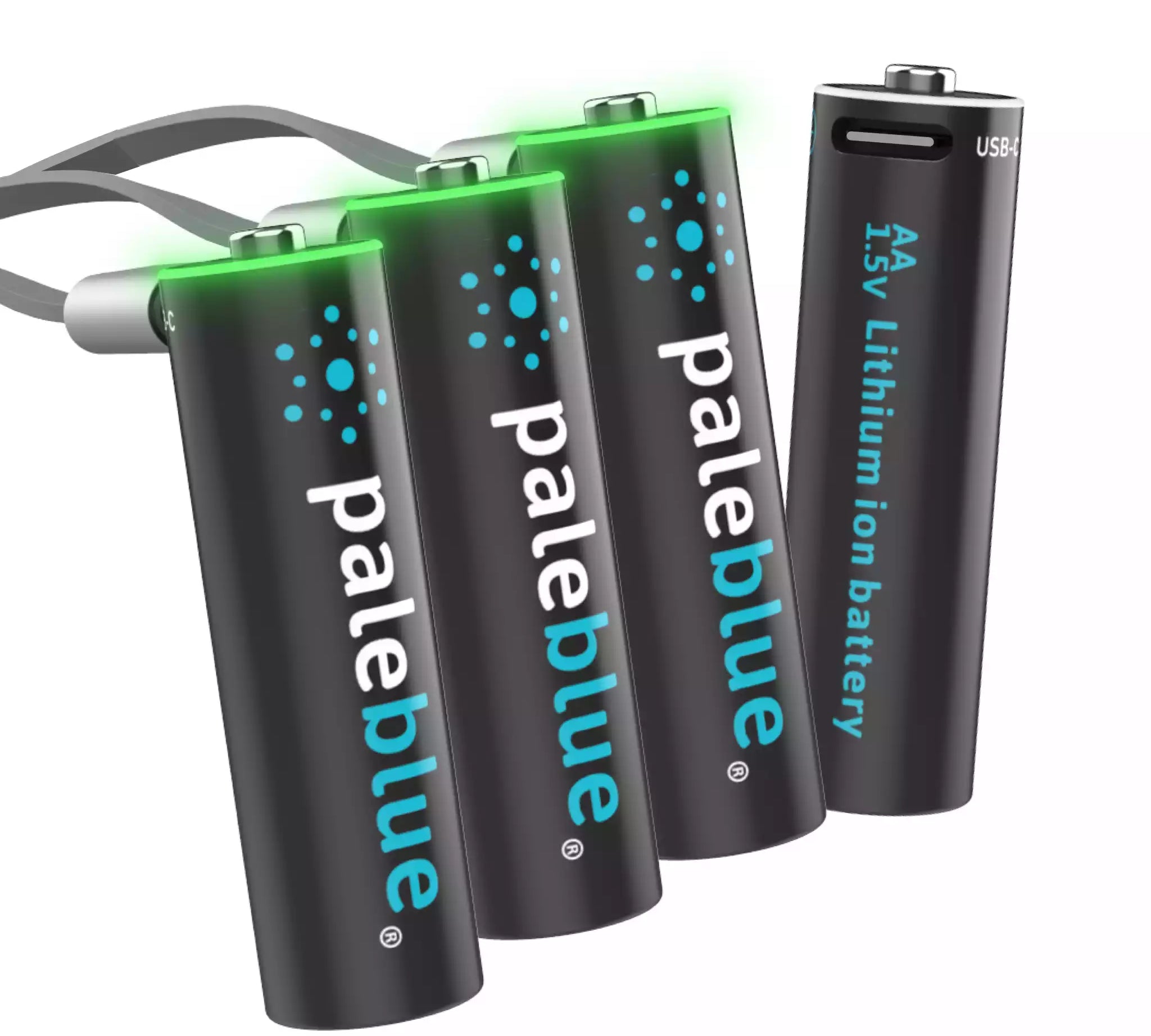
In 2026, a new generation of lithium-ion rechargeable AAs has changed the equation. These batteries deliver 1.5 volts (matching standard alkalines), charge quickly via USB-C, and don't require an external charger at all.
So which rechargeable AA batteries are actually worth buying today? Here's what matters and what most "best of" lists get wrong.
Before comparing specific brands, you need to understand the two fundamentally different technologies on the market:
NiMH (Nickel-Metal Hydride) The legacy technology. Brands include Panasonic Eneloop, Energizer Recharge, AmazonBasics, IKEA LADDA, EBL, and GP ReCyko. These batteries output 1.2 volts, require an external charger, and have relatively high self-discharge rates. They're proven, inexpensive, and widely available.
Li-ion (Lithium-Ion) with USB-C The newer approach from brands include Paleblue. These batteries output a constant 1.5 volts, charge via a built-in USB-C port, and have low self-discharge. They're more expensive per battery but eliminate the need for a separate charger.
This isn't a small difference; it's a fundamentally different experience.

Here's something most battery review sites gloss over: the 1.2V vs 1.5V difference causes real problems in certain devices.
Standard alkaline AA batteries deliver 1.5V. Every consumer device with an AA battery compartment was designed around that voltage. Most devices tolerate the 1.2V output of NiMH cells just fine. Your TV remote doesn't care about voltage. But devices with tighter voltage requirements can misbehave:
Smart locks may show premature low-battery warnings or fail to operate
Some digital devices may not power on at all with 1.2V cells
Gaming controllers may exhibit reduced rumble intensity or connection issues
Photography flashes may recycle slower with the lower voltage
Lithium-ion rechargeable AAs solve this by delivering a regulated 1.5V output throughout the entire discharge cycle. An integrated circuit inside each battery maintains constant voltage until the cell is depleted, at which point it shuts off cleanly rather than sagging gradually like a NiMH cell.
Energy capacity (mWh, not just mAh): Battery capacity listed in milliamp-hours (mAh) only tells part of the story, because it doesn't account for voltage. A 2,000 mAh NiMH cell at 1.2V delivers 2,400 mWh of energy. A 1,700 mAh Li-ion cell at 1.5V delivers 2,550 mWh. The Li-ion battery actually stores more usable energy despite the lower mAh number. When comparing across chemistries, always look at milliwatt-hours.
Charge method: NiMH batteries require an external charger ($15-25 additional cost). Li-ion USB-C batteries charge from any USB port like your laptop, a power bank, a car charger, a wall adapter you already own. For travelers, outdoor enthusiasts, and anyone who values simplicity, the USB-C approach is transformative.
Self-discharge rate: NiMH batteries lose charge while sitting idle. Even the best (Eneloop) lose about 30% after a year. Li-ion batteries with protection circuits retain significantly more charge in storage, making them a better choice for devices you don't use daily.
Cycle life: Most NiMh rechargeable batteries are rated for 500-1,000+ cycles. In practice, you’re lucky to get a few hundred before performance dips considerably. Lithium rechargeable AA batteries like Paleblue are rated 1,000 cycles and are backed by a lifetime warranty.
Safety certifications: For Li-ion batteries, look for IEC certification and integrated protection circuitry that guards against overcharge, short circuit, and overheating.
For everyday devices (remotes, clocks, keyboards, mice): Any quality rechargeable AA will work. If budget is the priority, NiMH options like Eneloop or IKEA LADDA are solid. If you want the convenience of USB-C charging and never buying a charger, Paleblue is the better pick.
For high-drain devices (gaming controllers, camera flashes, motorized toys): This is where higher-capacity NiMH (2,500+ mAh) cells like the Eneloop Pro shine on raw runtime. But if your device is sensitive to voltage, and many gaming controllers are, a 1.5V Li-ion like Paleblue will deliver more consistent performance even with slightly less total capacity.
For infrequently-used devices (emergency flashlights, seasonal items, backup gear): Lithium-ion wins clearly here. Low self-discharge means your batteries will still have charge when you need them months later. NiMH self-discharge makes them a poor choice for "set it and forget it" applications.
For smart locks, doorbells, and IoT devices: Use 1.5V lithium-ion rechargeable batteries. Many smart locks explicitly warn against using 1.2V NiMH rechargeable batteries. Paleblue's 1.5V output, low self-discharge, and 12-month dormant life make them well-suited for these devices.
For travel and camping: USB-C rechargeable batteries eliminate the need to pack a dedicated charger. Charge from a power bank, solar panel, or laptop. Paleblue batteries also include recycled-plastic travel cases for easy packing.
The math is straightforward. A pack of 24 Duracell alkaline AA batteries costs about $16, or roughly $0.67 per battery. At moderate use (replacing batteries monthly), that's about $8 per year per device.
A 4-pack of Paleblue rechargeable AAs costs $29.99 and replaces 1,000+ packs of disposables over its lifetime. Even at 100 cycles, the cost per use drops below $0.07, ten times cheaper than disposables. At 500 cycles, it's under $0.02 per use.
NiMH options are cheaper up front ($8-12 for a 4-pack) but require a charger ($15-25) and rarely last the stated cycle rating. Total first-time investment: $23-37. Per-cycle economics are similar.
Either way, rechargeable batteries pay for themselves within a few months of regular use.
The "best" rechargeable AA battery depends on what you value most. If raw mAh capacity per dollar is the only metric, NiMH cells like the Panasonic Eneloop Pro still lead. If you want the simplest, most modern experience: true 1.5V voltage, USB-C charging from any port, no external charger, and minimal self-discharge, lithium-ion options like Paleblue represent where the category is heading.
For most households switching from disposable batteries for the first time, we'd point you toward Paleblue. The USB-C charging removes the biggest friction point in the rechargeable experience (buying and dealing with a charger), and the 1.5V output means you won't run into compatibility issues with any of your devices.

